This week confirmed something important:
Financial planning is no longer simply evolving through better products, platforms, or regulation.
It is beginning to split into two very different futures:
One optimises institutions.
The other restores human agency.
Across AI, regulation, adviser business models, consumer capability, and trust, the underlying pattern is becoming harder to ignore.
Here are this week’s key developments shaping the future of Total Wealth Planning.
🔷 Academy of Life Planning
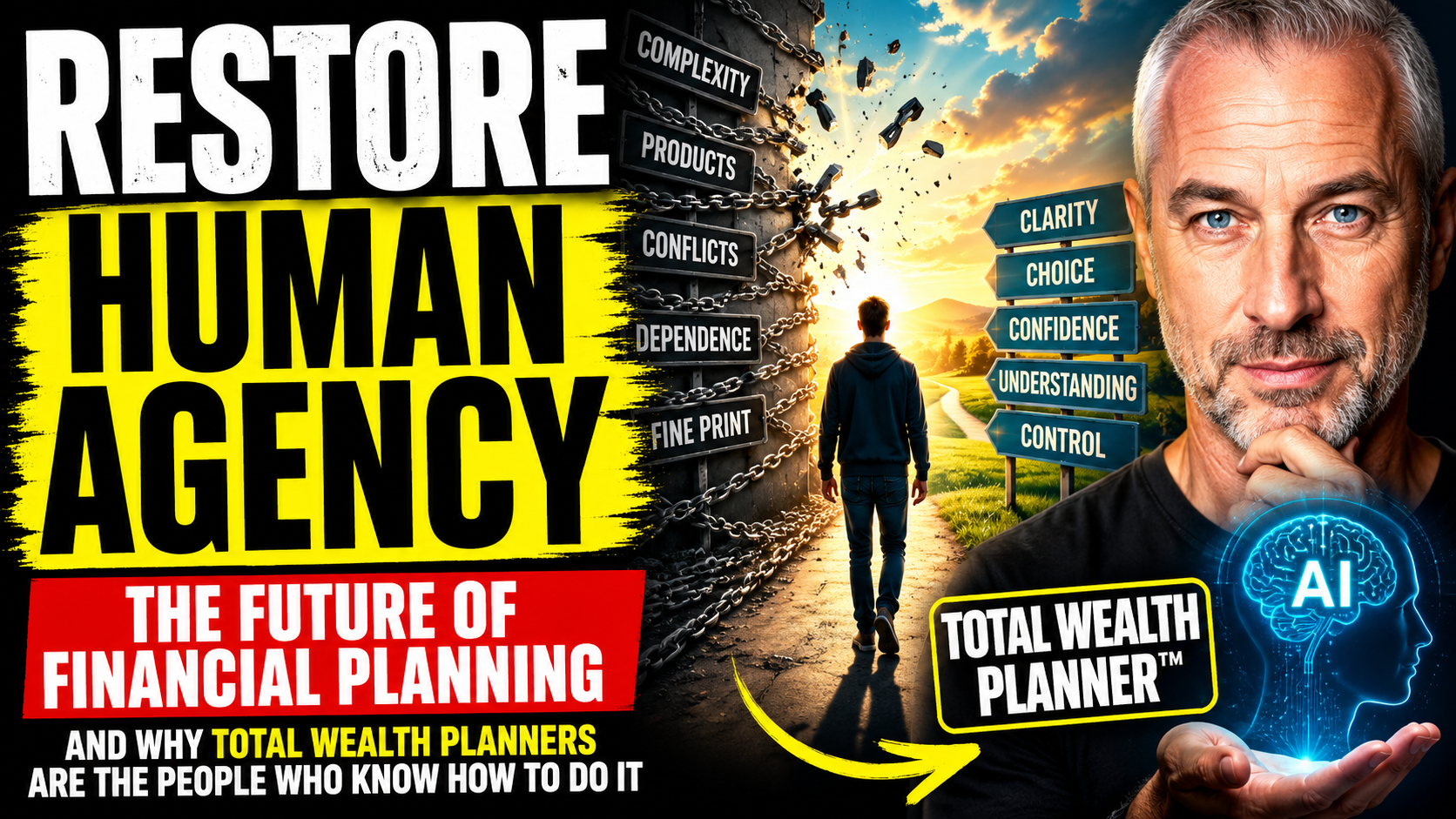
Restore Human Agency — and What That Means for the Future of Financial Planning
For decades, financial planning largely operated on the assumption that people needed experts to take control.
But AI is changing the economics of knowledge itself.
The future may belong less to product distributors… and more to capability builders, thinking partners, and planners who help people navigate complexity.
👉 Explore the shift: “Restore Human Agency — and What That Means for the Future of Financial Planning”
The Industry Is Starting to Move Toward Total Wealth Planning
Many of the themes long discussed inside the Academy are now beginning to appear more visibly across the wider industry:
- Human outcomes over product outcomes
- Behaviour and wellbeing alongside money
-
AI-enabled capability
- Planning beyond accumulation
The language may differ. But the direction of travel is becoming clearer.
👉 Read the full breakdown: “The Industry Is Starting to Move Toward Total Wealth Planning”
The Faster the System Becomes, the More Capable People Must Become
The UK government is signalling a future of:
- Faster innovation
- Faster regulation
- Faster financial systems
But faster systems increase the cost of poor judgement.
In a high-speed world, human capability may become the defining protective asset.
👉 Understand what this changes: “The Faster the System Becomes, the More Capable People Must Become”
🧠 Human Capital
The Missing Asset in Britain’s Retirement Debate
15 million people are reportedly heading toward inadequate retirement outcomes.
The default response remains:
- Save more
- Invest more
- Work longer
But what if the missing asset is not just pension capital… but human capital?
Skills. Adaptability. Community. Meaning. Capability.
👉 Explore the wider picture: “The Missing Asset in Britain’s Retirement Debate”
12.2 Million People Are Being Told They Face Pension Poverty. But What If the Missing Asset… Is You?
This week continued a growing conversation around self-agency and productive longevity.
The question is quietly shifting from:
“How large is the pension pot?”
Towards:
“How capable is the person?”
👉 Read the reflection: “12.2 Million People Are Being Told They Face Pension Poverty”
🤖 AI / Markets / Industry Shift
OpenAI’s New Financial Planning Tool Raises a Bigger Question
OpenAI launched a new personal finance experience for US Pro users this week.
That matters.
But the deeper question may be:
Who shapes the assumptions underneath AI-driven planning systems?
If agency-centred thinkers do not participate, incumbent assumptions may quietly become the default operating system for financial planning.
👉 Explore the implications: “OpenAI’s New Financial Planning Tool Raises a Bigger Question”
The AI Capability Gap May Become Society’s Next Big Inequality
The FCA says “hundreds” of firms are now applying to its AI sandbox.
That suggests:
- Institutions are rapidly scaling AI capability
-
Regulators are building AI capability
- Scammers are building AI capability
Which raises a simple societal question:
What happens if ordinary people are left behind?
👉 Read the full article: “The AI Capability Gap May Become Society’s Next Big Inequality”
Only 7% of Advisers Fully Trust Their Technology Outputs
Institutional systems are often presented as:
-
More auditable
- More repeatable
- More controlled
Yet adviser trust in those systems appears remarkably low.
The contradiction matters because it raises a deeper issue:
Technology trust is not just about process accuracy. It is also about human judgement and interpretability.
👉 Understand the tension: “Only 7% of Advisers Fully Trust Their Technology Outputs”
The 90/10 Is Becoming the 99/1
Rising adviser minimums may be one of the clearest signals yet that the traditional advice market is structurally narrowing.
If advice thresholds continue rising:
- fewer people gain access to human guidance
- more people navigate complexity alone
- demand for AI-assisted capability systems grows rapidly
The future may not be “advice for all.”
It may become capability support for the many… and bespoke advice for the few.
👉 Explore the structural shift: “The 90/10 Is Becoming the 99/1”
🛡️ Get SAFE
If Institutions Have AI, Regulators Have AI, and Scammers Have AI… Then Individuals Need AI Too
AI is no longer just a productivity story.
It is becoming a power story.
If large institutions can use AI to:
- optimise systems
- monitor behaviour
- analyse consumers
-
accelerate decision-making
then individuals may require their own trusted “second brain” capability simply to maintain balance.
👉 Read the article: “If Institutions Have AI, Regulators Have AI, and Scammers Have AI… Then Individuals Need AI Too”
The Hidden Money in the Small Print
A growing number of modern financial harms do not arise from outright fraud.
They arise from:
- complexity
- asymmetry
- misunderstanding
-
behavioural overload
This is one of the drivers behind The Leveller™ and the wider movement toward informed consent.
👉 Explore the issue: “The Hidden Money in the Small Print”
The Right to Understand Before You Lose Everything
Modern systems often assume:
“If you signed it, you understood it.”
Real life is rarely that simple.
Stress, grief, pressure, urgency, trust, fatigue, and information overload all affect human decision-making.
This may become one of the defining consumer protection issues of the AI era.
👉 Read the full piece: “The Right to Understand Before You Lose Everything”
Restoring Human Agency Without Surrendering Your Data, Judgement, or Autonomy
This week also highlighted growing concerns around:
- public AI tools
- confidentiality
- governance
-
data exposure
- over-dependence on opaque systems
The future of AI in planning may depend not only on capability…
but on who controls the operating system.
👉 Explore the implications: “Restoring Human Agency Without Surrendering Your Data, Judgement, or Autonomy”
📊 Market & Industry Observations
Fiduciary or Free Thinker?
This week’s discussions continued to expose an uncomfortable tension inside modern financial advice:
Is the future adviser primarily:
a fiduciary product gatekeeper?
or
a human capability partner?
The distinction matters more than many realise.
👉 Read the article: “Fiduciary or Free Thinker?”
Beyond Distribution
Some firms are beginning to reconsider the long-term sustainability of purely distribution-led models.
AI, fee pressure, rising thresholds, and changing client expectations are all accelerating the conversation.
👉 Explore the shift: “Beyond Distribution”